


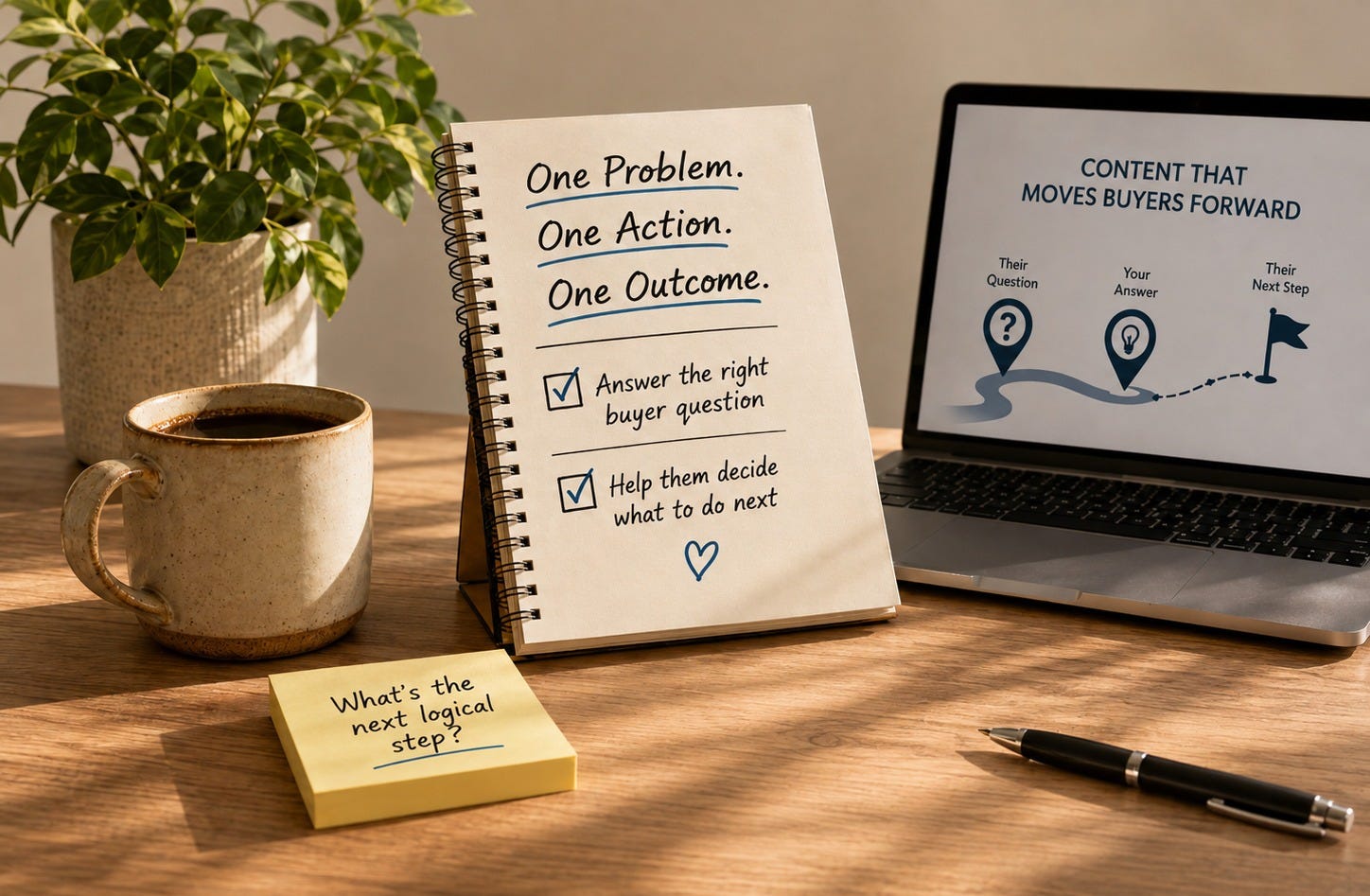
In my article about creating content that helps people decide whether to work with you, I suggested looking through emails, call notes, DMs, feedback forms, and transcripts for the questions people ask before they buy.

That can leave you with a long list.
So now what?
I come back to a question a business mentor drilled into me years ago:
What’s the next logical step?
If you have 20 questions sitting in front of you, start with the one that can help someone decide what to do next.
I call this decision weight: how much answering a question can help someone make a useful decision.
A question has more decision weight when your answer can help someone choose, compare, rule something out, take action, or decide whether an offer fits.
There’s another test I keep coming back to:
One problem. One action. One outcome.
I use this idea when I think about building simple AI tools. It works just as well for content.
One useful piece of content can address one clear problem, help someone take one useful action, and move them closer to one outcome.
That gives you a much better way to decide what deserves your publishing time.
How to choose which buyer questions deserve content first
Frequency matters. It doesn’t get the final vote.
You might hear the same question 20 times and still decide it isn’t worth writing about right now.
Maybe the question attracts people who are unlikely to buy.
Maybe it sits far away from the work you want to be known for.
Maybe the answer leads to more research with no clear action.
Maybe it sends you into a topic you no longer want to spend time on.
Your publishing time is limited. Every topic you choose means another topic waits.
Ask:
Will answering this help the right person make a useful decision?
That gets much closer to the job your content needs to do.
Buyer questions about price, fit, timing, and risk
Questions with strong decision weight aren’t always the easy ones.
They may be about:
price
fit
limitations
timing
risk
what happens after someone buys
when your offer may be a poor fit
whether someone can solve the problem without buying anything
Those questions can feel harder to answer in public. They can still be some of your strongest topics.
Someone considering an AI consultant may care far more about “Do I need a custom AI app for this?” than “What is generative AI?”
A traveler planning Japan may care more about “Is paying a travel advisor worth it for this trip?” than “What are the top things to see in Tokyo?”
A reader considering a nonfiction book may want to know, “Will this help me if I already know the basics?”
A business owner considering coaching may be asking, “Do I need private help, or can I get what I need from a group program?”
Each question sits close to a decision.
That gives it more decision weight.
Why buyer questions matter before someone contacts you
A lot of research happens before someone contacts a business.
The 2025 6sense Buyer Experience Report, based on nearly 4,000 B2B buyers, found that buyers completed about two-thirds of the buying process before speaking with sellers. Source: 2025 6sense Buyer Experience Report
The 2024 Edelman-LinkedIn B2B Thought Leadership Impact Report found that 75% of decision-makers and C-suite executives said a piece of thought leadership led them to research a product or service they had not been considering. Source: LinkedIn and Edelman
These studies focus on B2B buying, so I wouldn’t apply the percentages to every type of business.
The useful point is that your content may be answering questions long before someone sends an email, fills out a form, buys a book, books a trip, or signs up for a program.
That gives your answers real work to do.
Start with buyer questions closest to a decision
Here’s how I’d look at a few examples.
A nonfiction author
Say you wrote a book for people considering a career change after 50.
Readers keep asking:
“Will this book help me if I’ve already changed careers once?”
That question has high decision weight.
The reader is trying to decide whether your book fits their situation.
A useful article could answer that one question directly.
Problem: The reader isn’t sure the book fits their experience.
Action: Read your explanation and compare it with their situation.
Outcome: Decide whether to buy the book.
That piece has a clear job.
A broad article about building a reading habit may be useful. It sits much farther from the decision to buy this book.
An AI builder consultant
An organization asks:
“Do we need a custom AI app, or can we use tools we already have?”
That question carries a lot of decision weight.
The consultant can explain what they consider before recommending a build: the task, repeatability, available data, how many people use it, and what needs to happen after the AI produces an answer.
A good answer might lead someone to decide they don’t need a custom build.
I think that is worth saying.
Your judgment becomes more visible when you explain the cases where buying from you may not be the best next step.
A travel advisor
A traveler asks:
“Is it worth using a travel advisor for a 10-day trip to Japan?”
There’s a decision sitting inside that question.
A travel advisor can explain what makes a trip more complex, what planning support includes, where an advisor can save time, and what type of traveler may prefer to plan alone.
The content addresses one problem.
The reader takes one action: compare their trip with the criteria.
The outcome is a decision about whether to ask for help.
A business coach
A business owner asks:
“Would private coaching or a group program fit me better?”
That question gives the coach room to show how they think.
The answer could cover the amount of feedback the person wants, the pace they prefer, how much outside perspective they need, and how independently they work.
The reader leaves with a clearer way to choose.
That carries more decision weight than another broad article about the benefits of coaching.
Use the One Problem. One Action. One Outcome. test
Take one question from your list and run it through this test.
One problem
What is the person trying to figure out?
Keep it narrow.
“Should I use a travel advisor for Japan?” is clear.
“How do I plan better trips?” covers a much larger topic.
One action
What can the person do after reading?
They might:
compare options
assess fit
review criteria
choose a format
calculate a cost
rule something out
book a conversation
read a sample
request more information
If you can’t name the action, the topic may still be too broad.
One outcome
What decision becomes easier?
Maybe they decide to buy the book.
Maybe they decide they need an AI assessment before commissioning a build.
Maybe they choose private coaching.
Maybe they decide to plan the trip themselves.
That last one counts.
Your content has done useful work when it helps the right person make a sound decision, including a decision that doesn’t end in a sale.
A 4-part test for ranking buyer questions
Some questions belong in your content now. Others can wait.
If I were sorting a list, I’d ask 4 things:
Does this question come up more than once?
Can the answer change a buying decision?
Does answering it let me show how I make decisions?
Does it connect to work I want more of?
A question that scores high on those 4 points goes near the top.
A question can come up all the time and still rank low if it has little connection to what you sell or where you want your business to go.
That is a judgment call.
A formula can sort the list. Your experience decides what deserves your attention.
Want help deciding which content questions deserve your attention first? I can help you sort the priorities and create a clear plan in Clarity & Action.
Use the buyer’s exact question in your content
When you find a strong question, keep the original language.
If someone asks:
“Do I need a custom AI app for this?”
Keep it.
If a traveler asks:
“Is a travel advisor worth it for Japan?”
Keep it.
If a business owner asks:
“Should I choose private coaching or a group?”
Keep it.
Those words tell you how the person is thinking about the decision.
They can give you a title, an FAQ, an email subject, a video topic, or the opening for an article.
They can help search engines and AI systems connect your content with the language people use when they look for an answer.
Try this AI prompt
Use AI to help sort the questions. Keep the final call for yourself.
I have a list of real questions from people who may buy my book, product, service, program, or expertise.

My audience is:
[describe your audience]

My offer is:
[describe the offer]

Here are the questions:
[paste questions]

Help me find the questions with the highest decision weight.

For each question, assess:

1. What problem is the person trying to solve?
2. What decision may sit behind the question?
3. What single action could my content help them take?
4. What single outcome could that action lead to?
5. Does this question give me room to share my experience and judgment?
6. How closely does it connect to the work or offer I want more people to consider?

Do not assume how often I hear each question. Ask me.

After I answer, rank the top 5 questions.

For each one, explain why it deserves priority and where my own experience or judgment needs to appear.

Do not write the content.
AI can sort and compare.
You make the call.
Choose one buyer question and answer it well
You don’t need a 3-month editorial calendar before you can publish something useful.
Pick one question.
Make sure the problem is clear.
Give the reader one useful action.
Help them reach one clear outcome.
Then ask yourself the question I keep coming back to:
What’s the next logical step?
That answer can lead you to the next piece.

Questions, comments, and feedback are welcome. Post in the comment thread below.

Useful content answers a question. Valuable content helps someone make a decision.
To me that is what matters because more information isn't the problem anymore. We can find answers almost instantly. The harder part is figuring out what applies, what doesn’t, and what is actually worth doing next.
That’s where useful information becomes valuable judgment. Not “here are five ways you could do this.” (The good ole listicle) More like: here’s what matters, here’s what I’d rule out, and here’s the decision you’re actually trying to make.