



The Death of the Robotic Prompt
We have officially entered the era of the “lifeless inbox.” You know the smell of it: an email arrives that is grammatically perfect, structurally sound, and entirely devoid of a soul. In the early days of the generative explosion, we were intoxicated by speed. Today, that novelty has curdled into “AI fatigue.” Your audience has developed a sixth sense for the assembly-line output of a “polished” prompt, and they are clicking away in droves.
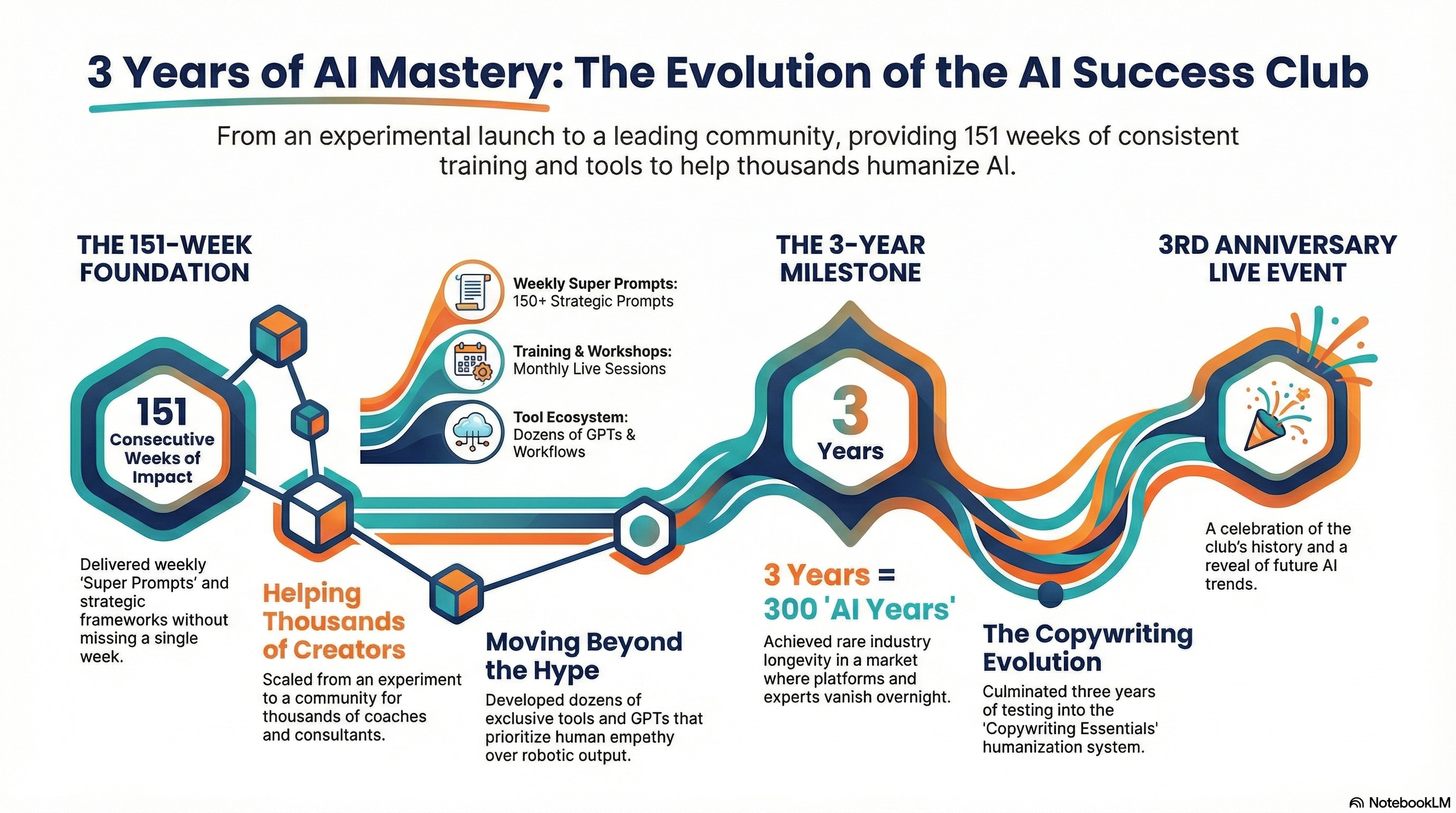
For the past 151 consecutive weeks, the AI Success Club has been a laboratory for this exact friction. After three years in the trenches—which, in the hyper-accelerated timeline of AI, is equivalent to 300 years of traditional marketing evolution—the verdict is clear: speed is now a commodity, but human connection is a high-yield asset. To survive the next wave, we must stop treating AI as a vending machine for content and start using it as a precision instrument for human resonance.
Takeaway #1: Clarity is No Longer Enough (Emotion is the New Conversion Engine)
Generating 1,000 words in 30 seconds isn’t a competitive advantage; it’s a liability if those words don’t make the reader feel something. Most marketers blame a failing funnel on a weak headline or a poor offer, but the actual culprit is a lack of emotional resonance. Clarity helps a reader understand the message, but only emotion moves them to reach for their credit card.
We’ve found that high-converting copy requires a humanizing bridge. We use a framework called “Describe Their Day” to sharpen empathy before the AI ever touches the draft.
The Exercise: Write 2–3 sentences describing your audience’s secret struggles.
The Humanized Example: Instead of “Users need better email tools,” try: “You open your inbox and sigh. Another AI-generated email. It’s polished, but lifeless. It doesn’t make you feel anything—and worse, it sounds just like the last one.”
By feeding this visceral context into tools like The Humanizers GPT, you inject empathy and persuasive rhythm into the draft, moving beyond mere information to true connection.
If your copy doesn’t make people feel something, it won’t move them to act.
Takeaway #2: Speed Isn’t Your Problem—Voice Is
The great AI lie is that it “saves time.” In reality, if the output doesn’t sound like you, that saved time is immediately incinerated by three hours of manual rewriting. Every time you have to “fix” a robotic AI draft, you chip away at your creative energy and your brand identity.
The solution is to establish “Voice Anchors” to ground the technology in your unique personality.
The Voice Anchor Exercise:
Identify 3 Tone Words: (e.g., “Direct, witty, empathetic”).
Select 2 Frequent Phrases: (e.g., “Let’s fix that” or “No fluff”).
Anchor the Output: Direct the AI to prioritize these markers.
To solve the “robotic cadence” problem, we developed the Voice Unmasker GPT. This isn’t just a tool; it’s a conceptual reset that erases the predictable, clinical tone of standard LLMs and restores the natural, human rhythm of your specific brand voice.
Takeaway #3: The “Old School” Revival in a High-Tech World
As “experts” chase the latest shiny plugin, the most effective AI strategies are actually a return to the foundational masters—Ogilvy, Bernbach, and the principles of Neuro-Linguistic Programming (NLP). Timeless psychology outperforms modern technical hacks because human buying triggers haven’t changed in centuries.
In the trenches, we’ve integrated these triggers into the AI NeuroCopy framework. This involves using AI to apply the “E-Piphany Method,” which reverses the persuasion process to reveal an audience's hidden emotional tipping points. A primary application is Emotional Contrast:
Undesirable State: “Right now, your copy sounds polished, but robotic.”
Desirable State: “Imagine a writing tool that speaks in your voice, feels alive, and connects instantly.”
By using AI to revive these “old school” methods, you stop fighting the algorithm and start engaging the human brain.
Takeaway #4: Longevity is the Ultimate AI “Flex”
In the generative tech space, three years is an eternity. While most “AI influencers” appeared last Tuesday, our 151 weeks of consistent, daily experimentation has taught us that the real “flex” isn’t knowing a new prompt, it’s having the orientation to anticipate where the tech is going.
Staying ahead of the curve requires a shift from prompting to thinking. Longevity gives you the perspective to see through the hype cycles and focus on what provides leverage for a business.
In an industry obsessed with ‘new,’ longevity is the real flex.
Takeaway #5: The Shift from Output Machines to Strategic Teammates
The final transition is moving away from the “cookie-cutter” approach of one-off prompts toward the “Legacy Vault” philosophy. This is a commitment to deep-dive mastery over shallow, fleeting shortcuts.
In the AI Success Club, the Legacy Vault includes over $6,000 in foundational training, from Renegade Prompting to the Sales Page Architect. The goal is to treat AI as a high-level strategic teammate. You aren’t just “asking for an email”; you are collaborating with an Ogilvy Copy Expert GPT or a Sales Page Architect that understands frameworks, not just grammar. This is the shift from using AI as a “replacement” for your work to using it as a “multiplier” for your strategic intent.
The Future of the “Humanized” Creator
The philosophy of the “humanized” creator is simple: be smarter, faster, and more effective without losing the “you” in the loop. As we look toward 2026 and beyond, the technology will only become more ubiquitous, making your unique perspective the only true scarcity left in the market.
In a world where AI can copy your data, your formats, and your speed, there remains one thing your competitors will never be able to replicate.
What is the one thing your competitors can’t copy?
The answer is your voice and your humanity. The third anniversary of the AI Success Club isn’t a finish line. It’s the baseline for a more sophisticated human-AI partnership. The creators who thrive won’t be those who use AI the most, but those who use it to become more unmistakably themselves.

Join me and Andy O'Bryan and celebrate the 3 year anniversary of the AI Success Club during a live (on Zoom) event on Tuesday, February 17 at 10 am PT/ 1 pm ET.
Details and free registration here.

Great advice, love the Describe My Day tip, very useful