


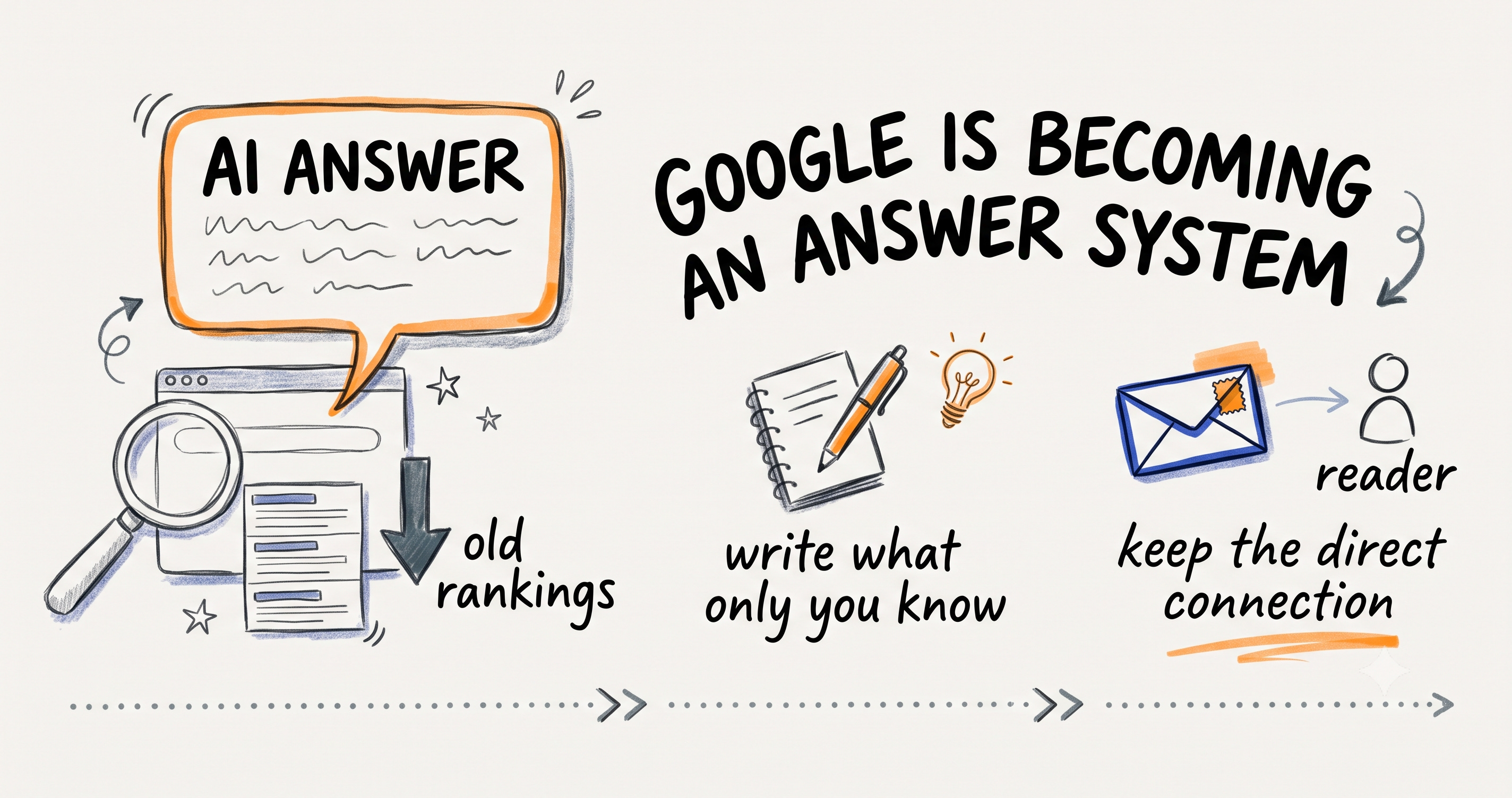
Google Search looks very different this week.
AI-generated responses now take a much bigger role in how people find information. In many searches, the answer appears before the familiar list of website links. People can ask follow-up questions and continue searching without leaving Google.
For a solo business owner who depends on search traffic, this raises a fair question:
Will people still visit my website?
Some will. Many may get what they need from the AI response and move on.
That makes the content inside the answer more important than its old ranking position.
What changed in Google Search
Google announced a new AI-powered Search box in May 2026. Gemini 3.5 Flash is now the default model in AI Mode across the countries and languages where the feature is available.
The search box accepts longer questions, images, files, videos, and open Chrome tabs. A person can move from an AI Overview into a longer conversation without starting a new search. Google says users will continue to see links and other types of results.
TechTimes reported that the AI response now takes the primary position in search results, with traditional results farther down the page. Classic links remain available through Google’s Web filter.
The exact search screen may vary by user, location, account, and query. The bigger change is harder to miss:
Google is becoming an answer system, not simply a list of pages.
What this means for your website traffic
An AI response may give the searcher enough information to skip the website visit.
TechTimes cited research showing lower click-through rates when an AI answer appears.
A Pew Research Center study found that people clicked a traditional search result during 8% of visits when an AI summary appeared, compared with 15% when one did not. Only 1% clicked a source link inside the summary.
An Ahrefs study found that the presence of an AI Overview correlated with a 58% lower average click-through rate for the top-ranking page.
A separate 2026 study found that Google AI Overviews reduced traffic to matched English-language Wikipedia pages by about 15%. The largest declines appeared on topics where a short answer could satisfy the search.
Traffic reports may start telling a different story. A page could influence a buyer’s decision without earning a click. Your expertise may appear in a summary, comparison, recommendation, or follow-up answer.
This makes traditional traffic numbers less complete.
Keep tracking visits, email signups, inquiries, and sales. Add a few other checks:
Search your main topics in Google AI Mode, ChatGPT, and Perplexity.
Look for your business name, website, ideas, and examples.
Note which pages get cited.
Watch for inquiries from people who say they found you through an AI tool.
Ask new clients how they first heard about you.
This gives you a better view of how your content is being found.
Your old SEO work still matters
You don’t need to rewrite your website for every Google announcement.
Clear pages, descriptive titles, useful headings, internal links, original examples, and accurate information still help search systems read your work. Google’s AI features rely on web sources. The system needs pages it can find, interpret, and quote.
Your content now has 2 related jobs:
Give a person a useful reason to visit your site.
Give AI systems clear information they can connect to your name and business.
I’ve written about several parts of this process in my AI SEO article collection, including how ChatGPT cites content, how AI recognizes expertise, and how answering the next reader question adds useful context.
This Google update adds urgency to that work. It doesn’t change the basic approach.
Want your content to show up when buyers ask AI for help?
I built two Claude Skills that find the questions your clients are actually asking, then draft answers in a format built for citation. Check out the Get Cited by AI Skill Bundle.
Write the part only you can provide
Short factual answers are easy for AI to summarize.
Your experience gives your content more value.
Add details drawn from your work:
What have you seen happen with clients?
What mistakes come up again and again?
How do you decide which approach fits?
What conditions change your advice?
What steps do you follow?
What happened when you tested the idea yourself?
A generic article may give AI a definition. An experience-based article gives it a source worth naming.
For example, a marketing consultant could write a basic article explaining how to choose a social platform. The same consultant could add the 5 questions she asks clients, the signs that a platform is taking too much time, and a story about a client who chose email over Instagram.
The second version carries more evidence of expertise. It gives a reader a reason to visit the source and learn more.
Connect each topic to your business
Getting mentioned in an AI answer has limited value when the topic has no connection to your services.
Review your recent content and ask:
Which offer does this support?
Which buyer question does it answer?
What experience does it show?
What useful next step can the reader take?
Where can someone learn more from me?
This connection matters more as clicks become harder to earn.
A person who visits your site after reading an AI summary may arrive with a specific question. Make the next step easy to spot.
That next step could be:
Read a related article.
Download a checklist.
Join your email list.
Review a service.
Submit an inquiry.
Book a consultation.
One clear invitation is enough.
Build topic depth one useful question at a time
AI search often turns one question into a conversation.
Someone may start with:
How can a consultant get more clients?
Then ask:
Which marketing method works with a small audience?
How long should it take?
What can I do each week?
How do I know whether it’s working?
A single article rarely answers the full set.
You can build stronger coverage by publishing connected articles that answer the next useful question. Link them together. Keep each page focused. Give readers a clear way to continue.
This helps people. It gives search systems more context about your work, your point of view, and the topics connected to your name.
Your website becomes a stronger source when several pages show consistent expertise.
Don’t depend on Google to keep the relationship
Search platforms control what people see before they reach you.
Your email list gives you a direct way to stay connected after they arrive.
Review the pages that receive the most search traffic. Check whether each page has a clear invitation to subscribe. The invitation should match the article.
An AI SEO article could provide a visibility checklist. A content planning article could offer a weekly planning template. A client-attraction article could lead to a visibility assessment.
The offer should continue the same conversation.
This gives the visit somewhere useful to go, especially when search traffic becomes less predictable.
A 30-minute visibility check
You can respond to this Google change without spending a week rebuilding your site.
Choose 1 page connected to an offer you want to sell.
1. Search the main question
Run the question through Google, Google AI Mode, ChatGPT, and Perplexity.
Write down:
Which sources appear
What the answer covers
What it leaves out
Whether your page appears
Which follow-up questions the tool suggests
2. Review your page
Look for:
A direct answer near the top
Clear headings
Your own process
An example from your work
Your point of view
Links to related pages
A clear next step
3. Add one missing piece
Choose the strongest gap.
You might add a client example, a short process, a comparison, a common mistake, or a question the current page does not answer.
4. Connect the page to another useful resource
Add a link to a related article or service page. Give the reader somewhere logical to go next.
5. Track what happens
Check the search again in a few weeks. Note any new citations, changes in wording, traffic shifts, and inquiries.
AI answers change often. One search is a snapshot.
What I’m doing next
I’m paying less attention to the idea of holding one fixed search position.
AI-generated answers can use different sources for similar versions of the same question. Citations may change from one search to the next. A page can appear in an answer without ranking first in the traditional results.
I’m focusing on work I can control:
Publishing clear answers
Showing how I think
Adding firsthand examples
Connecting related questions
Giving visitors a reason to subscribe
Tracking inquiries along with traffic
Google will keep changing its search experience. Our response can stay fairly simple.
Make your expertise clear. Publish it on a website you control. Connect each page to a useful next step. Give people a direct way to stay in touch.
That work remains useful across traditional search, AI search, email, social content, and client conversations.
For paid subscribers, I’ve included an AI prompt that reviews a web page and identifies 5 ways to improve the page/article so it appears as a useful source in Google AI mode, ChatGPT, Claude, Perplexity and other answer based search tools.