


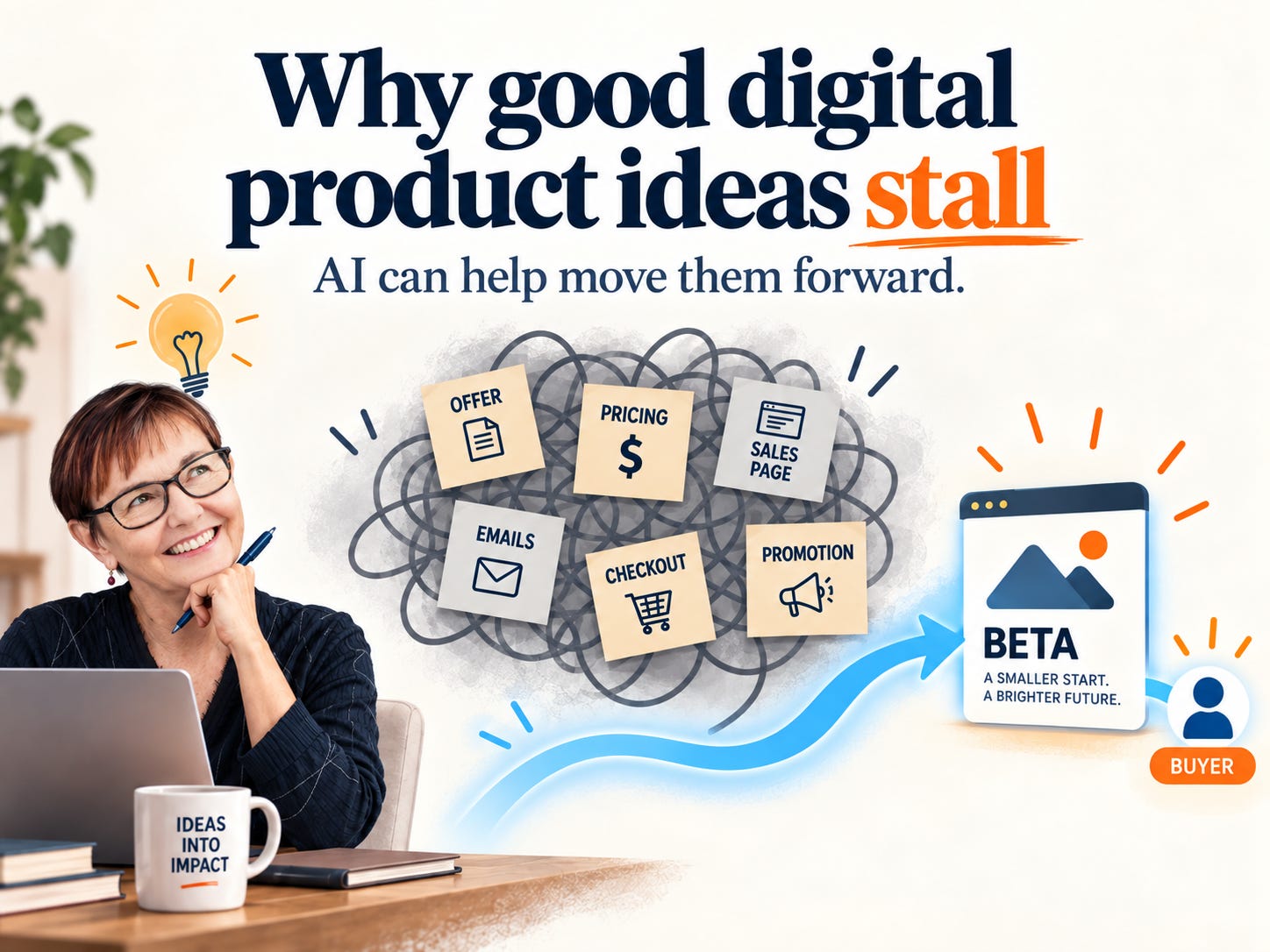
You probably have more product ideas than you have time to create.
A question clients ask repeatedly. A process you use in your work. A workshop you could turn into a self-study resource. A checklist, guide, template, or training based on something you already know well.
You may already have half of it somewhere. Old workshop slides, a Google Doc you started months ago, notes from client sessions, a checklist you made years ago, a training recording you forgot about, or a folder full of ideas you still think have potential.
I know that feeling well.
I’ve been a solo business owner for 24 years. I’ve had plenty of ideas I thought could become good digital products. Then I’d start thinking through everything that had to happen before someone could buy one.
Define the offer. Decide what goes in it. Set the price. Create the product. Write the sales page. Set up the checkout. Write the emails. Plan the promotion. Create the graphics. Test everything.
I could do all of it. At this point, I could probably do most of it in my sleep.
I was tired just thinking about doing all of it.
Sometimes I procrastinated long enough that someone else created something similar. Other times I decided the idea simply wasn’t worth all the work required to get it up and out the door.
AI has changed that calculation for me.
I’m more willing now to take an idea, create a beta version, put it in front of people, and see whether there’s a response. I can find out whether an idea deserves more of my time without turning it into a major project first.
That’s a big difference for one person running a business.
Getting an idea out the door takes more work than it seems
Creating the product itself may be the part you enjoy.
You know the topic. You understand the problem. You know what people ask you and how you usually help them.
Then come all the tasks surrounding the product.
You need to decide who it’s for, how much belongs in it, what format makes sense, and what to charge. Then there’s the name, description, sales page, checkout page, emails, promotional content, delivery, and follow-up.
Knowing how to do those things doesn’t create more hours in the day.
And the decisions are connected. Change the audience and the sales copy changes. Change the scope and the price may need another look. Change the promise and the promotional emails may need revision.
One decision you haven’t settled can add another afternoon of work later.
This is one reason a promising idea can stay in a folder for months. You can see all the work waiting on the other side of the idea.
I certainly can.
Sometimes experience makes me hesitate
There’s an odd side effect of doing this for a long time.
I know what comes next.
Someone newer to product creation may think, “I could turn this into a course.”
My brain immediately starts running through the next 30 things that will need to happen before that course makes a sale.
The knowledge is useful. It has saved me from making plenty of poor decisions.
It can make me hesitate too.
I’ve talked myself out of products that might have been worth testing because I pictured the finished version and everything required to get there.
That’s one of the biggest changes AI has made for me.
I don’t have to approach every idea as if I’m committing to the full finished product. I can test a smaller version first.
How AI helps me test digital product ideas faster
For me, creating and selling digital products with AI is less about asking it to come up with ideas.
I have ideas.
What I want is a partner that helps me move an idea through the work that comes next.
AI can help a solo business owner move a product idea through planning, first drafts, sales copy, and promotion faster, making it easier to test a beta before investing weeks in a finished product.
If I’m considering a new product, I can use AI to work through questions such as:
Is the problem clear enough?
Who is most likely to buy this?
What belongs in a beta version?
What material do I already have?
What could I leave out for now?
What price range makes sense?
What questions will a buyer probably have?
What needs to be on the sales page?
What promotional content will I need?
I can work through those questions much faster than I used to.
And some days, I simply want a first draft I can react to instead of another blank page.
The U.S. Chamber of Commerce reported in 2025 that 58% of small businesses were using generative AI, up from 40% the year before. That doesn’t surprise me. The practical appeal for a solo business owner is easy to see. There are only so many hours available, and AI can take on some of the work that used to consume those hours. Source: U.S. Chamber of Commerce
The order of the work matters
Years of creating products have taught me one decision often affects several that follow.
You need enough clarity about the buyer before writing the sales page. You need a defined offer before deciding whether the price makes sense. The finished offer and sales message give you the material for the campaign.
That matters when you put a project aside for 2 weeks because client work got busy.
I’ve reopened projects and spent the first half hour trying to remember what I had already decided.
What was the price?
Was this going to include the bonus?
Who did I decide the product was for?
Which version of the description was final?
AI can help keep those decisions together.
That’s the kind of partnership I find useful. I want a place to put the details so I don’t have to rebuild the project every time I come back to it.
It helps with consistency too.
If product planning happens in one conversation, sales copy in another, and launch planning somewhere else, the offer can start changing along the way. The buyer shifts. The promise gets rewritten. The promotion introduces another angle.
Then you’re spending time bringing everything back together.
I’d rather carry the decisions forward and keep working from the same source material.
Why digital products are still worth creating
With all those steps involved, it’s fair to ask why I keep creating digital products.
One reason is they give people an easy way to use my expertise.
Someone may read my newsletter for months without needing private consulting. A past client may need help with one specific problem. A new reader may want to learn from me before considering a larger purchase.
A focused product gives that person somewhere to go.
They can solve one problem, learn one process, use one template, or take one useful action without making a larger commitment.
Products also help keep your business top of mind.
You can write about the problem the product addresses, answer related questions, share examples, teach parts of the process, and refer people to the product when the topic comes up in a newsletter, podcast, social post, or conversation.
You’re giving people more opportunities to encounter your expertise and remember what you do.
A smaller product gives a buyer a chance to experience how you think and work. That can matter later when they need more help.
And after years in business, you may already have much of the product sitting in your files.
A workshop you taught 5 years ago may contain a process people still need. A client exercise may become a useful template. A group of articles may contain the beginnings of a guide. A training recording may contain an idea worth updating.
The work doesn’t have to stay buried in a folder.
Which product idea should you test first?
If you have several ideas, choosing one can become another reason to put the whole thing off.
I tend to look for 3 things:
People already ask me about the problem.
I have useful experience or material I can draw from.
The result is easy for a buyer to understand.
That gives me something concrete to work with.
I’m less interested these days in starting with the biggest product I can create. I’d rather start with something useful, get it in front of buyers, and learn from their response.
A beta makes that possible.
It lets me find out whether people understand the offer, whether the problem matters enough for them to pay for help, what questions they ask, and what they want more of.
Then I can decide what deserves more work.
That feels very different from spending weeks building something and hoping I made the right choices.
Try one idea for 20 minutes
Pick one question clients or customers ask you repeatedly.
Set a timer for 20 minutes and write down:
who asks the question
what result they want
how you currently help them
what material you already have
the smallest useful resource you could create around it
Then stop.
You don’t need to name the product, build the sales page, or start creating slides.
You’re deciding whether this idea deserves another hour of your attention.
That’s a much smaller commitment.
And if the answer is yes, AI can help you take the next step.

Years of doing this work shaped the AI process
This is where Prompt. Write. Sell. 2.0 came from.
Andy O'Bryan1 and I have each spent years creating, selling, promoting, testing, and revising digital products. We’ve had offers that needed more thought, sales pages that needed another pass, launches with too many moving parts, and products that changed halfway through the process.
We’ve learned which questions need answers before pricing, when an offer is getting too big, what buyers need to see on a sales page, and how much promotion makes sense for a particular product.
I learned those lessons by doing the work.
We built them into 3 Claude Skills.
Digital Product Navigator works through the product idea, buyer, scope, format, pricing, content, and business case.
Sales Page Architect picks up from there and works through the buyer’s problem, outcomes, benefits, proof, objections, FAQs, and sales copy.
Liftoff uses the finished offer and sales message to work through campaign timing, emails, promotional angles, social posts, and the other pieces needed to bring the product to market.
The biggest benefit is continuity. I don’t have to keep starting over.
The decisions made while planning the product carry into the sales page. The sales page carries into the launch.
It’s much easier to work on a product in pieces between everything else going on in my business.
I still want to make the decisions
AI can produce options faster than I can. I like that.
I still decide whether the product solves a problem my audience cares about. I decide when the scope has grown too big, whether the price feels right, whether a claim is true, and whether a launch plan fits my audience and my schedule.
Those are decisions I want to make.
What I’m happy to hand off are many of the tasks surrounding those decisions.
I don’t need to create every first draft myself. I don’t need to reorganize the same information several times. I don’t need to turn every sales-page section into emails and social posts on my own.
After 24 years of running a solo business, getting help with those parts feels pretty good.
AI doesn’t replace what I know.
It gives me a partner for putting what I know to work.
An idea doesn’t have to become a big project
If you have a product idea sitting in a folder somewhere, I hope you feel a little more willing to look at it again.
You may already have the expertise. You may already have much of the material. And you probably know more about creating the product than you give yourself credit for.
You can start smaller than you might have a few years ago.
Take one idea. Create a useful beta. Let AI help with the research, organizing, drafting, checking, and promotional tasks. Put the offer in front of people and see what happens.
Then decide what it deserves from you.
That’s the biggest change for me.
Ideas that once felt like too much work to pursue now feel possible to test.
Prompt. Write. Sell. 2.0 grew out of the way Andy and I have learned to work through these decisions over years of creating and selling products. It includes Digital Product Navigator, Sales Page Architect, and Liftoff, along with installation instructions and a guide for using the process with other AI platforms.
If you have an idea that keeps getting pushed down the list, learn more about Prompt. Write. Sell. 2.0 and see if it can help you get that idea up and out the door.

Andy and I are Co-Founders of the AI Success Club, launched in February 2023.