


A strong article gives you a starting point. The next piece should prove you can answer the question that comes after it.
Last week, I wrote about how AI LLMs decide what to cite for AI Search and why clear, useful content gives AI tools something better to work with.
That article started with a question from a luxury travel advisor:
“If I answer the right questions on my site, will ChatGPT or Perplexity ever mention my business?”
My answer was yes, when your content is clear enough for AI tools to understand, connect, and reference.
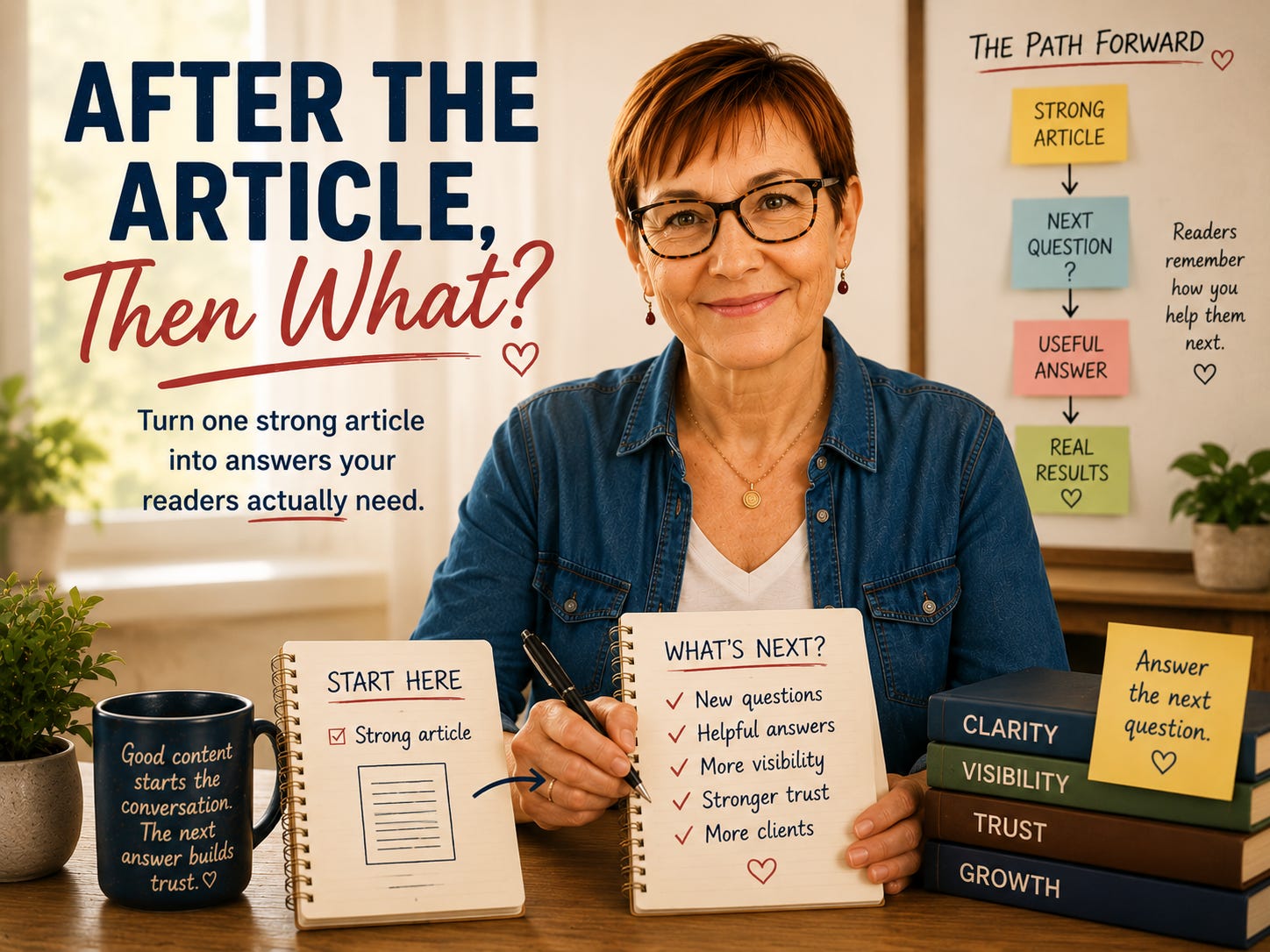
This week, I want to take that idea one step further. Once you publish one strong article, the next move matters. A lot.
Repurposing can make good ideas smaller
You know the routine. You write a good article. Then you pull a quote for LinkedIn. Turn a section into a short post. Make a graphic. Create a Note. Maybe record a short video.
I’ve done all of that.
For a long time, it’s what other creators and I recommended for smart content marketing. One idea. Several formats. More chances for people to see it.
Then I started to notice something in my own work.
Some pieces were helping the reader. Others were just proving I could extract more content from the original article.
The article had the strongest thinking. The repurposed pieces were often smaller, thinner versions of the same point. They looked useful at a glance, but they didn’t answer anything new.
And if the follow-up piece doesn’t answer anything new, why should a reader spend time with it?
The better follow-up question
After I publish a strong article, I look for the next question it creates. That one question changes the work.
A strong article should make a reader think. It should help them connect the idea to their own business and wonder what to do next. That next question is where the useful follow-up content lives.
For example, if you write an article about how AI tools cite content, the next question might be:
“How do I make my existing content easier for AI tools to understand?”
That could become a checklist.
Another reader may ask:
“What kind of questions should I answer on my website?”
That could become an FAQ page.
Someone else may wonder:
“Where should I put these answers?”
That could become a short article about website structure.
Each follow-up makes the original article more useful.
AI visibility needs developed thinking
AI tools work better with clear answers, useful examples, and enough context to connect your ideas across several pieces.
That matters because AI search is starting to connect ideas across your body of work. One article may introduce your point of view. The follow-up pieces show whether you can keep answering useful questions around that topic.
This is where many creators weaken their own visibility. They publish one strong piece, then cut it into short posts that all say the same thing. A posting schedule can look consistent while the body of work stays thin.
Depth shows up when you answer the next question, give a real example, and name the tradeoffs your reader has to deal with. That’s the kind of content that gives readers a reason to trust you. It also gives AI tools more context to work with.
Want your content to show up when buyers ask AI for help?
I built two Claude Skills that find the questions your clients are actually asking, then draft answers in a format built for citation. Check out the Get Cited by AI Skill Bundle.
The authority test
Here’s the test I’m using more often now:
Does this follow-up piece prove I can answer the next question?
When the piece answers a real next question, I’ll consider creating it. When it doesn’t, I leave it in my notes.
A quote can work when it clearly names the main idea.
A checklist can work when it helps someone act.
A Note can work when it gives one complete thought.
An FAQ can work when it answers a question people are likely to search.
A graphic can work when the idea is hard to understand in plain text.
I choose the job of the piece before I choose the format.
A simple example
Let’s say a business consultant writes an article called:
“How to Know When Your Offer Is Too Complicated”
That article may be strong on its own. It explains the problem. It gives signs to watch for. It makes the reader aware of something they may have been tolerating for too long.
The next question might be:
“How do I simplify my offer without losing the parts clients value?”
That could become a follow-up article.
Another question might be:
“What are the signs my clients are confused before they buy?”
That could become a checklist.
A third question might be:
“What should I change on my sales page first?”
That could become an FAQ answer or short website update.
Each piece earns its place because it answers something the original article brought up.
Where to put the next piece
Let the question guide where the content belongs.
If someone would search for the answer, put it on your website.
If the answer shows your point of view, LinkedIn may be a good fit.
If it’s a short observation that can stand alone, use Substack Notes.
If the idea needs context, examples, and your personal take, use your newsletter.
If the answer helps someone take action, turn it into a checklist, prompt, or short worksheet for subscribers.
The right answer belongs where your reader is most likely to use it.
Your next step
Choose one article you’ve already published.
Read it like a client or reader who is smart, busy, and trying to apply the idea to their own business.
Then write down 3 questions they might ask next.
Choose the strongest question.
Create one follow-up piece that answers it clearly.
That’s it.
This is the kind of repurposing I trust more now because it keeps the original thinking intact and gives the reader somewhere useful to go next.
A strong article is worth more than one round of promotion.
It can start a trail of useful answers that help readers understand your thinking and apply it to their own business. That’s where repurposing gets more interesting to me now. The follow-up piece becomes proof you can keep answering the questions your work raises.
So before you turn your next article into a batch of smaller posts, pause and ask one question:
What will my reader need next?
Answer that well, and your content starts doing a better job for your readers, your visibility, and the body of work you’re building over time.

For paid subscribers, I’m sharing the exact process I’d use to turn a long-form article into stronger follow-up content using AI.
You’ll get a step-by-step workflow and one detailed prompt that helps you find the next reader question, choose the right format, draft the follow-up piece, and check whether it sounds specific enough to publish.

