



You’ve probably tested your name or business in ChatGPT.
You asked a question related to your work. You scanned the answer for your name. Maybe you checked the links to see whether your website appeared.
That kind of test can satisfy your curiosity. It doesn’t tell you much about where your best opportunities are.
A stronger AI visibility check starts with the questions your ideal clients ask before they hire someone. Then you study which sources AI cites when answering those questions.
That is where citation research becomes useful.
What an AI citation can tell you
A citation appears when an AI answer links to a source that supports a claim, recommendation, definition, example, or instruction.
A mention works differently. The AI may name you or your business without linking to your content.
A citation gives the reader a path to your website. It can introduce your ideas to someone who has never heard of you.
That still doesn’t make every citation worth chasing.
A citation attached to a broad question such as “What is digital marketing?” may bring little business value to a visibility consultant. A citation attached to “How can a solo consultant stay visible without posting every day?” is much closer to a client problem.
The question behind the citation matters as much as the citation itself.
What I mean by a citation slot
A citation slot is the part of an AI answer where the system uses an outside source to support one point.
One answer may contain several slots.
For example, someone asks:
How can a solo consultant stay visible without spending hours on social media?
The AI answer might cover:
Choosing one primary platform
Publishing on a steady schedule
Reusing one idea in several formats
Tracking which content brings inquiries
Each point may cite a different source.
Those are 4 separate citation slots. Each source earns its place by supporting one part of the answer. This changes how you study AI visibility. You’re no longer looking at a list of websites and wondering why they appeared. You’re looking at the job each cited page performed.
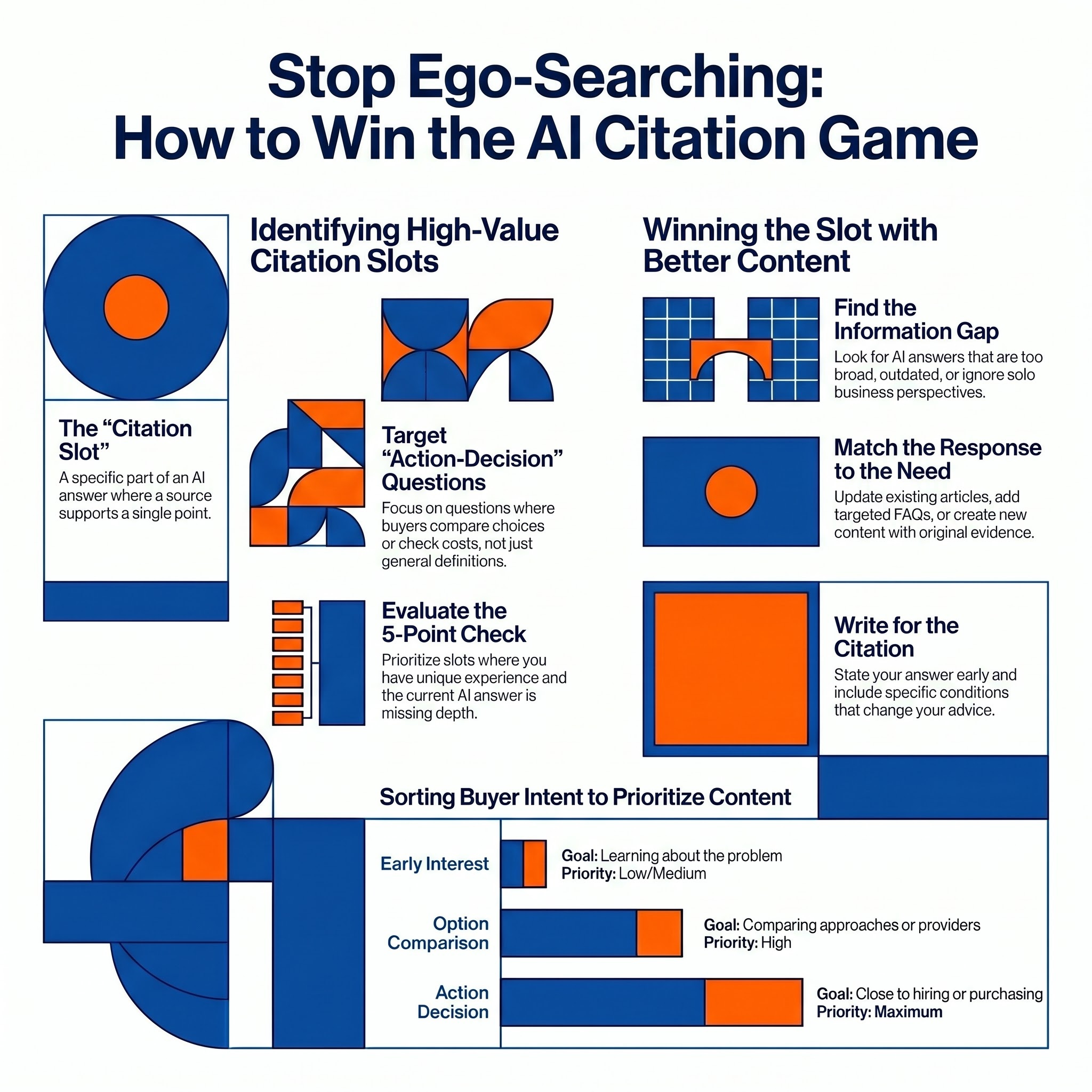
The citation slot method
I use 4 questions to study each slot.
1. What buyer question triggered the answer?
Start with a question connected to a real client concern.
A travel advisor might study:
Is it worth using a travel advisor for a complicated European trip?
A web designer might study:
How much should a small business website cost?
A business coach might study:
How do I know whether I need a coach or a consultant?
These questions sit close to a decision. The person asking may be comparing choices, checking costs, or deciding whom to trust.
That makes the citation more relevant to the business.
2. What claim did the citation support?
Open the cited source and find the part that relates to the AI answer.
The citation may support:
a definition
a price range
a step in a process
a warning
a recommendation
a comparison
an example
a result
Write down the exact purpose of the citation.
“HubSpot was cited” tells you very little.
“HubSpot was cited to support the recommended posting frequency” gives you something you can study.
3. Where does the question sit in the buyer’s decision?
I sort questions into 4 groups.
Early interest
The person is learning about the problem.
Examples:
What is AI visibility?
Why does online visibility matter?
How often should a small business publish content?
Problem recognition
The person knows something is wrong and wants an explanation.
Examples:
Why is my content getting views without inquiries?
Why doesn’t ChatGPT cite my website?
Why am I posting regularly without getting clients?
Option comparison
The person is comparing approaches, providers, costs, or tools.
Examples:
Should I hire a consultant or join a group program?
Is a custom website worth the cost?
Is it better to use a travel advisor or book everything myself?
Action decision
The person is close to taking the next step.
Examples:
What should I ask before hiring a visibility consultant?
How much should I budget for a brand website?
What information does a travel advisor need before planning my trip?
Citation slots tied to comparison and action questions often deserve more attention. They sit closer to a purchase.
Your business model still matters. An early-interest question may be useful when it brings the right people onto your email list. The point is to know why you want the citation.
4. What earned the source its place?
Study the cited page for evidence.
Look for:
a direct answer near the top
first-hand experience
original examples
a clear process
current facts
useful comparisons
stated limits or conditions
proof that supports the claim
This step keeps you from copying a competitor’s headline or article structure.
You’re trying to see what made the source useful to the answer.
How to run a citation check
Start with 5 questions tied to your offer.
Choose questions your ideal client asks before making a decision. Client emails, sales calls, discovery calls, comments, and search queries are better sources than a generic keyword list.
Run each question in the AI platforms your audience is most likely to use. Record the date, platform, question, answer, and cited sources.
AI answers can change. One test is a snapshot, so repeat your highest-priority questions on another day before making a major content decision.
For every citation, record:
the cited page
the claim it supported
where it appeared in the answer
the buyer-intent group
what evidence the source provided
whether the citation connects to your offer
A simple spreadsheet is enough.
Which citation slots are worth pursuing?
Use this 5-point check:
My ideal client asks this question.
The question relates to a service or product I sell.
I have real experience or evidence to add.
The current AI answer leaves out something useful.
A reader who clicks could take a sensible next step with me.
A slot that meets 4 or 5 points is worth serious attention.
A slot that meets 1 or 2 points may be interesting without supporting a business goal.
Seeing a competitor’s name can trigger the urge to create content around every topic they cover. That spreads your effort across questions that may never lead to a subscriber, inquiry, or sale.
Find the weakness in the current answer
Your opportunity comes from improving the answer.
Read the cited sources and ask:
Is the advice too broad?
Is the information old?
Does the answer ignore solo business owners?
Does it leave out cost, time, risk, or conditions?
Is the recommendation based on theory?
Is first-hand experience missing?
Does the answer tell the reader what to do next?
A missing perspective can give you a useful angle. So can stronger evidence.
Example: AI answers about content consistency may repeat the same advice about publishing on a schedule. Your experience may show that consistency depends on choosing a format the business owner can keep producing during busy client weeks.
That is a clear contribution. It adds judgment from real work.
Decide whether to update or create
Once you find a worthwhile citation slot, choose the right content response.
Update an existing article when it already answers the main question and needs a clearer section, stronger evidence, or a more direct explanation.
Add an FAQ when the question can be answered clearly in a few paragraphs and supports a service page or core article.
Create a new article when the question needs its own examples, process, comparison, or point of view.
Leave it alone when the question has little connection to your offer or you lack something distinct to add.
That last option matters. Your time has value. AI citation research should narrow your content choices.
Make your answer easier to cite
Once you select a slot, write for the reader first.
State the answer early. Explain your reasoning. Add evidence from your experience, examples, client patterns, original research, or trusted sources.
Include the conditions that change your advice.
For example, a useful answer to “How often should a consultant publish content?” would explain how the answer changes based on platform, sales cycle, audience size, available time, and content format.
That kind of answer gives an AI system more than a general statement. It gives the reader a better decision.
Track results that matter
A citation is one visibility signal.
Track whether the work leads to:
referral traffic from AI platforms
email subscribers
visits to relevant service pages
branded searches
inquiries
sales conversations
Citation patterns can change across platforms and over time. Review them as part of your visibility work.
The business result still counts most.
A prompt to build your first citation question list
Use this prompt to create a starting list:
I am a [profession] who works with [ideal client] and sells [offer].
Generate 15 questions this person may ask an AI assistant before deciding whether to hire someone, buy a service, or choose an approach related to [topic].
Sort the questions into these groups:
1. Early interest
2. Problem recognition
3. Option comparison
4. Action decision
Write each question in plain, conversational language.
For every question, explain:
- what decision the person is trying to make
- how closely the question connects to my offer
- what first-hand experience or evidence I would need to answer it well
Do not suggest questions that sit outside my services or experience.
Review the list using your own client experience. AI can help you draft the questions. Your sales conversations and client work tell you which ones deserve attention.
Build your citation slot plan
You now have a way to spot citation slots and judge which ones connect to a buyer’s decision.
The next step is choosing which opportunities deserve your time.
Paid subscribers can download the Citation Slot Plan, a step-by-step worksheet that helps you review cited sources, score each opportunity, and choose the right content response.